Categories
Spirituality

Let Go to Grow: The Hidden Power of Total Surrender (And How It Sets You Free!)

🌿 Introduction: Why “Letting Go” Is the Hardest and Most Powerful Choice

In today’s hyper-driven world, we are taught to chase, control, and conquer. But what if real strength doesn’t lie in control—but in letting goTotal surrender isn’t weakness. It’s the ultimate act of courage, where you give up resistance and open the door to a deeper intelligence—life itself.

This post explores the profound spiritual practice of surrender—what it means, why it’s so transformative, and how it can set you free from anxiety, fear, and inner chaos.


🧘‍♀️ What Is Total Surrender?

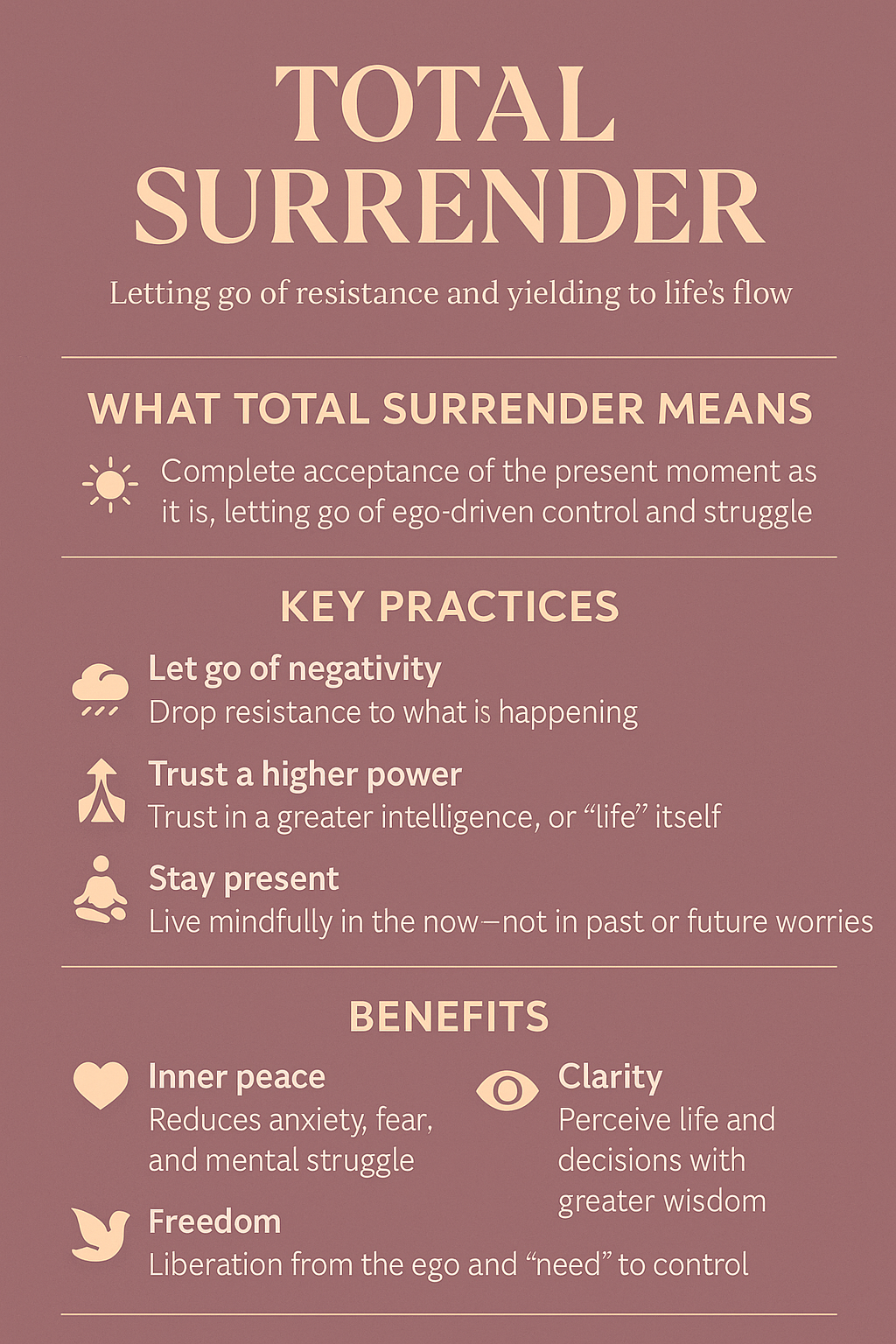
Total surrender means complete acceptance of the present moment—without resistance, expectations, or mental stories. It is a state of deep trust in life, the universe, or a higher power.

It doesn’t mean giving up on life or becoming passive. Instead, it’s about surrendering the illusion that you are the sole doer. You let go of ego-based control and allow life to flow naturally, responding with awareness rather than reacting with fear.


🔁 The Ego Wants Control—But the Soul Seeks Peace

The human mind wants security, predictability, and control. This is the root of much suffering. We constantly resist what is, and that resistance creates inner turmoil.

Total surrender dissolves this friction. When you surrender:

  • You stop fighting reality.
  • You release emotional baggage.
  • You open to grace, intuition, and peace.

It is the death of the ego, not the death of action. You still work, love, and live—but without mental weight.


🌀 Signs You’re Not Surrendering (Yet)

You may be resisting surrender if:

  • You feel mentally exhausted or overwhelmed.
  • You constantly worry about the future.
  • You’re stuck in past regrets.
  • You try to control people, outcomes, or even your own emotions.

These are signs the ego is at the steering wheel. Surrender invites you to step back and let awareness lead.


✨ What Happens When You Truly Surrender?

The transformation is radical:

  • Peace replaces panic.
  • Stillness replaces struggle.
  • Flow replaces force.

You begin to feel supported by something beyond your own limited thinking. Solutions arise spontaneously. People and events align. Life becomes effortless, not because challenges vanish—but because resistance does.


🛤️ How to Practice Total Surrender in Daily Life

  1. Observe without reacting
    Pause before responding. Watch your thoughts without judgment.
  2. Accept what you can’t control
    Whether it’s traffic, illness, or rejection—let it be. Acceptance dissolves pain.
  3. Stay present
    Surrender isn’t about giving up your goals—but about releasing anxiety about how and when they happen.
  4. Let go of mental stories
    “This shouldn’t have happened.” “I’ll never succeed.” These are ego narratives. Surrender means dropping them.
  5. Trust life’s intelligence
    Call it the universe, God, or your higher self—something bigger than your mind is in charge.

🌺 The Paradox: When You Let Go, You Gain Everything

Total surrender is the most active kind of passivity. You no longer act from fear or ego—but from clarity and intuition. Your energy stops leaking into worry and control. Instead, it returns to you as creative power, joy, and freedom.

You finally realize: you were never in control—but you were always supported.
Total-surrender-spiritual-stroll

🧭 Final Thought: Your True Power Begins Where Control Ends

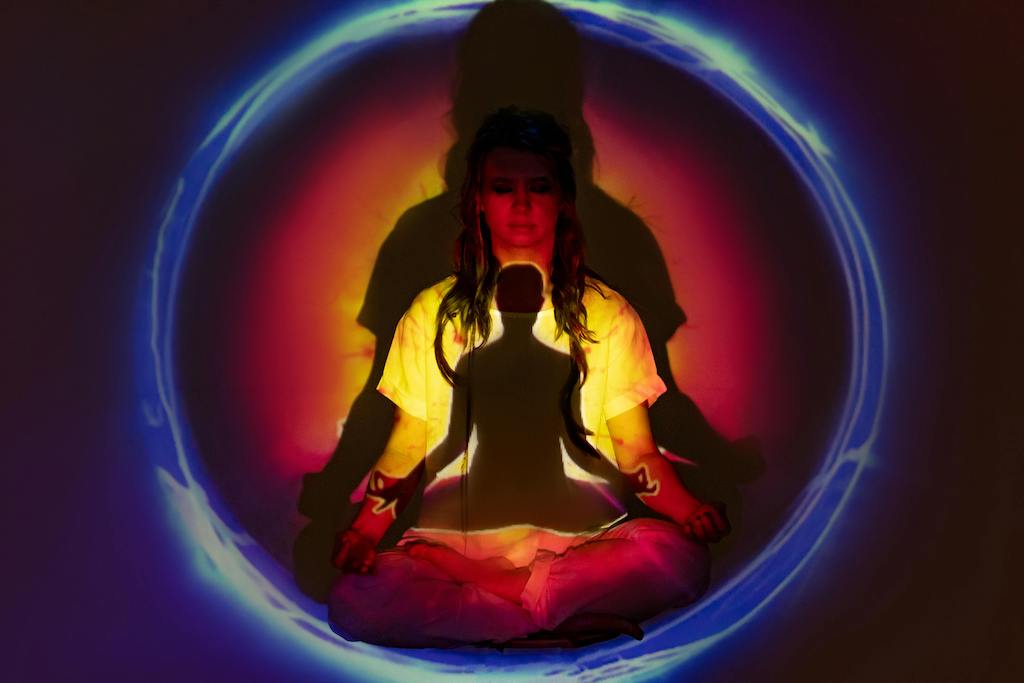
Total surrender is not a one-time act. It’s a moment-to-moment choice—a shift in awareness. It invites you to live lightly, flow gracefully, and respond with wisdom.

It doesn’t mean life becomes easy, but it becomes lighter. You suffer less, smile more, and touch the truth of who you are beneath the noise.

Let go… not because you must, but because you finally understand—you’re not giving up anything that was truly yours.

Categories
Philosophy Religion Science Spirituality

What is God? Does Science, Philosophy, or Faith Have the Answer?

That’s a deep question, and the answer depends on how you approach it—philosophically, scientifically, theologically, or personally. Let’s break it down into different perspectives:

1. Religious Perspective

In most religious traditions, God is a supreme being or ultimate reality, often seen as the creator of the universe. The nature of God varies:

  • Monotheistic traditions (Christianity, Islam, Judaism): God is an all-powerful, all-knowing, and ever-present being who created and governs the universe.
  • Polytheistic traditions (Hinduism, Ancient Greek, Norse): Multiple gods exist, each governing different aspects of life (e.g., war, love, wisdom).
  • Pantheistic traditions (Taoism, some Hindu views): God is not a separate being but rather the universe itself—everything is divine.

2. Philosophical Perspective

Philosophers have debated the concept of God for millennia:

  • Plato & Aristotle: Argued for a “Prime Mover” or first cause, an uncaused being that set everything in motion.
  • Descartes: Believed that the very idea of a perfect being (God) proves God’s existence.
  • Nietzsche: Declared “God is dead,” arguing that belief in a traditional God was declining in modern society.

3. Scientific Perspective

Science doesn’t prove or disprove God but explores the origins of the universe through natural laws.

  • Big Bang Theory: Describes how the universe expanded from a singularity, but doesn’t explain what (if anything) caused it. Some see God as the force behind it.
  • Fine-Tuning Argument: The universe’s physical laws seem precisely tuned for life, leading some to argue for a designer.

4. Psychological Perspective

  • Carl Jung: Argued that God is an “archetype” in human consciousness, meaning the idea of God is a universal part of the human mind.
  • Human Need for Meaning: Some theories suggest belief in God fulfills a psychological need for purpose, security, and understanding.

5. Atheistic/Agnostic Perspective

  • Atheists: Reject the idea of a deity, often arguing that belief in God is based on human imagination or ancient explanations of the unknown.
  • Agnostics: Take a middle ground, believing that we can’t know for sure whether God exists or not.

Final Thought

“God” is a concept that has evolved with human civilization, shaped by culture, philosophy, and personal experience. Whether one sees God as a literal being, an abstract force, or a psychological construct, the idea continues to shape how people understand the universe and their place in it.

What’s your own perspective on God? Do any of these ideas resonate with you?

Image Source: Pexels

Categories
Spirituality

What is the Real Meaning of Spirituality?

Spirituality delves into the profound, exploring the meaning behind this concept. But what precisely is the concept of spirituality? To unravel this, we must understand what spirituality means and the essence of being spiritual.

A spiritual person embodies a unique perspective, but what does it truly mean to be spiritual? The journey toward a spiritual life unfolds as we explore and seek to comprehend this elusive realm.

For those questioning, “What is called spiritual?” the answer lies in the interconnected threads of life. If you ponder, “What it means to be spiritual,” you’re on the path of self-discovery and connection with the greater whole.

So, how does one embark on this transformative journey? To truly understand, you may ask, “How do I become spiritual?” The answers lie in the exploration, contemplation, and a genuine quest for spiritual enlightenment.

The path of self-discovery is synonymous with spirituality. When the fundamental question, “Who am I?” arises within, the journey of spirituality commences. Unlike traditional rituals or patterns, this expedition doesn’t prescribe a set course or a mentor to follow. Imagine understanding light; you don’t need a specific path or ritual to acknowledge its presence—it simply is. Similarly, the essence of understanding doesn’t hinge on rituals like meditation; they may serve as stepping stones, calming the mind, but aren’t intrinsically linked to spirituality.

Embarking on spirituality doesn’t necessitate adherence to rituals, especially if the mind is restless. Unlike those who consider meditation or yoga as the ultimate goal, true spirituality involves grasping the significance of the present moment and the self. There’s no age barrier to initiating a spiritual journey, but a receptive, curious, and open mind is crucial. Spirituality doesn’t demand following a guru or abandoning everything; it beckons those who seek deeper connections and explore dimensions beyond materialism.

Questioning your identity and peeling away layers signify the initiation of spirituality. Unveiling the reality beneath the self reveals the profound truth that surpasses any worldly illusion. This quest for self-awareness leads to genuine freedom—a rhythmic connection with the universe’s pulse. Spirituality is not a radical transformation but a revelation of the authentic self that has always existed and will persist. In the profound words of the Upanishads, “Tatva masi” encapsulates the essence—You are that, eternal and unbound.

Image Source: Pexels