Categories
Spirituality

7 Powerful Stages of Spiritual Awakening That Can Completely Change Your Life

Have you ever felt that something inside you is changing, even though your external life looks the same? Perhaps you suddenly started questioning your purpose, feeling disconnected from old habits, or becoming more aware of your emotions and thoughts. Many people describe this experience as a spiritual awakening.

Spiritual awakening is often misunderstood as a single event or a magical moment of enlightenment. In reality, it is a process of inner transformation that can happen gradually over months or even years. It changes the way you see yourself, your relationships, and the world around you.

Every person experiences awakening differently, but many people go through similar stages during their journey.

Let’s explore the stages of spiritual awakening and understand what they may feel like.

What Is Spiritual Awakening?

Spiritual awakening is the process of becoming more aware of your inner self and gaining a deeper understanding of life beyond surface-level experiences. It often involves questioning old beliefs, developing self-awareness, and seeking meaning beyond material success.

Awakening does not necessarily mean following a religion. Instead, it often involves a stronger connection with your own consciousness, values, emotions, and sense of purpose.

Some people experience awakening after major life events such as:

  • Loss of a loved one
  • Breakups
  • Health challenges
  • Emotional pain
  • Success that still feels empty
  • Life-changing experiences

These situations sometimes act as triggers that push individuals toward deeper self-reflection.

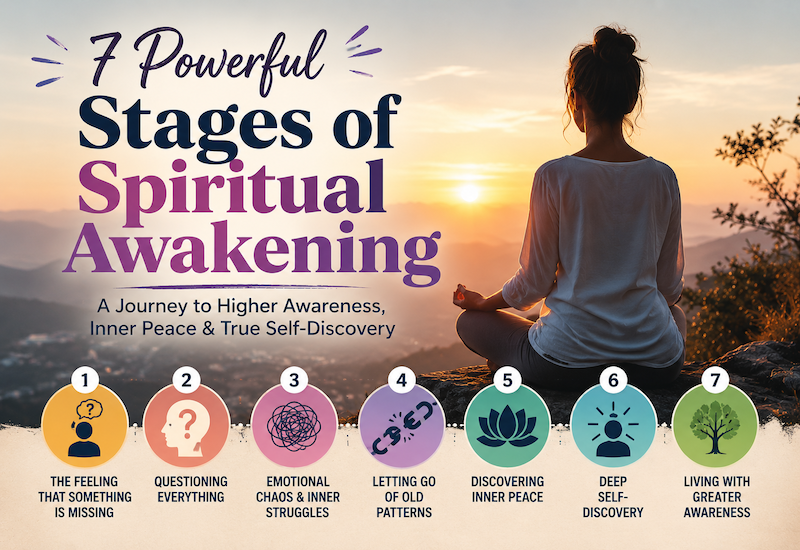
Stage 1: The Feeling That Something Is Missing

The first stage usually begins with an unusual feeling of dissatisfaction.

You may have a good job, relationships, or financial stability but still feel empty inside. Life starts feeling repetitive, and questions begin appearing in your mind:

  • “Why am I here?”
  • “Is this all there is?”
  • “What is my purpose?”

You may feel disconnected from activities that once made you happy.

This stage can feel confusing because you cannot clearly identify what is wrong.

Common signs:

  • Restlessness
  • Feeling emotionally detached
  • Loss of excitement
  • Increased curiosity about life

Stage 2: Questioning Everything

Once the feeling grows stronger, people begin questioning many things they previously accepted without thought.

You may start asking questions about:

  • Beliefs
  • Society
  • Career goals
  • Relationships
  • Personal identity
  • Success and happiness

Things you once considered important may suddenly lose meaning.

This stage can feel uncomfortable because old ideas begin collapsing before new understanding develops.

Common signs:

  • Overthinking
  • Desire for truth
  • Increased self-reflection
  • Feeling lost or confused

Stage 3: Emotional Chaos and Inner Struggles

Many people describe this phase as one of the most difficult parts of awakening.

As hidden emotions surface, unresolved wounds and fears may emerge.

You might experience:

  • Anxiety
  • Mood swings
  • Sadness
  • Anger
  • Loneliness
  • Emotional exhaustion

Some spiritual communities call this the “dark night of the soul.”

This stage is not punishment; rather, it is a process of releasing emotional baggage that has remained buried for years.

Inner healing often begins here.

Stage 4: Letting Go of Old Patterns

As awareness increases, many people naturally begin releasing things that no longer align with their inner values.

This could include:

  • Toxic relationships
  • Negative habits
  • Limiting beliefs
  • People-pleasing behaviors
  • Unhealthy environments

Letting go can feel painful because familiar things often provide comfort, even when they no longer serve us.

However, this stage creates space for growth.

Common signs:

  • Desire for simplicity
  • Setting boundaries
  • Reduced attachment
  • Greater emotional clarity

Stage 5: Discovering Inner Peace

After emotional turbulence begins settling, many people notice moments of peace and clarity.

You may become less reactive and more present in daily life.

Small things begin bringing joy:

  • Nature
  • Music
  • Silence
  • Gratitude
  • Genuine connections

Instead of constantly chasing external validation, fulfillment begins coming from within.

Common signs:

  • Increased calmness
  • Better emotional balance
  • Mindfulness
  • Greater compassion

Stage 6: Deep Self-Discovery

During this stage, you start understanding yourself more deeply.

You become aware of:

  • Your strengths
  • Your fears
  • Your values
  • Your true interests
  • Your emotional patterns

People often discover talents, passions, or dreams they had ignored for years.

You stop trying to fit into expectations created by others.

Instead, authenticity becomes more important.

Stage 7: Living With Greater Awareness

The final stage is not a permanent destination because spiritual growth continues throughout life.

However, people at this stage often experience:

  • Greater emotional intelligence
  • Inner peace
  • Compassion
  • Acceptance
  • Stronger purpose

Rather than seeking happiness outside themselves, they understand that fulfillment begins internally.

Life challenges still exist, but reactions become more balanced and conscious.

Signs You May Be Experiencing a Spiritual Awakening

If you are wondering whether you are going through an awakening, these signs are commonly reported:

  • Feeling more sensitive emotionally
  • Questioning your life purpose
  • Enjoying solitude
  • Increased intuition
  • Feeling disconnected from negativity
  • Strong desire for personal growth
  • Attraction toward spirituality or mindfulness
  • Desire for meaningful relationships

Experiencing these signs does not automatically mean something is wrong with you. Sometimes they simply indicate personal transformation.

How to Navigate Spiritual Awakening

Awakening can feel overwhelming, especially during difficult phases.

Helpful practices include:

Meditation

Meditation can help quiet mental noise and increase awareness.

Journaling

Writing thoughts and emotions often brings clarity.

Spending Time in Nature

Nature can create emotional balance and reduce stress.

Practicing Mindfulness

Staying present helps avoid becoming trapped in fear and overthinking.

Self-Compassion

Growth is rarely a straight path. Be patient with yourself.

Final Thoughts

The stages of spiritual awakening are not strict rules or fixed steps. People may move back and forth between stages, experience them differently, or skip some entirely.

Spiritual awakening is less about becoming someone new and more about remembering who you truly are beneath fear, conditioning, and expectations.

The journey may sometimes feel uncomfortable, but many people eventually discover that those difficult moments became the beginning of a deeper understanding of themselves and life itself.

Categories
Spirituality

If There Is No Doer, Who Is Living Your Life? The Spiritual Science of Action

What Does “No Doer” Really Mean?

“No doer” does NOT mean:
❌ You stop acting
❌ You become lazy
❌ Nothing matters

It means:
✔ Actions happen through the body-mind
✔ Thoughts arise automatically
✔ The sense of “I am the controller” is a mental label

Just like digestion happens without your control, many psychological processes also happen automatically.


Observe Your Own Mind

Try this simple experiment:

  • Don’t choose your next thought.
  • Just wait and notice.

You’ll see the next thought appears by itself.

You did not manufacture it consciously.

This simple observation reveals something profound:
👉 Thoughts happen — they are not authored.

The same applies to emotions, impulses, and many decisions.


Neuroscience Supports This View

The brain creates a sense of agency — a feeling that “I am doing this.”

But that feeling is generated after neural processes have already started.

So spirituality and neuroscience converge on the same insight:
The doer may be a constructed experience, not an independent entity.


Why This Insight Reduces Suffering

When you believe you are the absolute controller:

  • You blame yourself excessively.
  • You resent others deeply.
  • You fight reality constantly.

When you see causes clearly:

  • Compassion increases.
  • Understanding grows.
  • Mental resistance softens.

Pain may remain — suffering reduces.


But Why Does This Truth Feel So Threatening?

That’s where psychology comes in.

➡️ Continue to Part 4: Why the Mind Resists Truth

Categories
Science

Your Brain Decides Before You Do? The Neuroscience That Shook Free Will

The Shock That Changed the Free Will Debate

In the 1980s, neuroscientists discovered something uncomfortable:
Brain activity preparing an action appeared before people consciously decided to act.

This suggested that the brain might be initiating actions before awareness catches up.

In simple terms:
👉 The brain moves first.
👉 Conscious “I decided” comes later.

This challenged the idea that consciousness is the boss.


How Decisions Actually Form in the Brain

Modern neuroscience shows:

  • The brain constantly predicts outcomes.
  • It weighs memories, emotional states, rewards, risks, and habits.
  • Most processing happens unconsciously.

Conscious awareness sees only the final summary — not the complex computation behind it.

This is similar to how your phone shows a clean interface while thousands of processes run in the background.


Are We Just Biological Machines?

Not exactly.

The brain is not a mechanical switch — it is adaptive, learning, and plastic. It changes based on experience.

But the experience of choosing does not necessarily mean the choice was created freely from nothing.

The feeling of authorship may be:

  • A useful mental model
  • A coordination tool
  • A storytelling function of the brain

The Prediction Experiments

Later experiments showed that scientists could sometimes predict a person’s choice seconds before the person consciously knew their choice.

This does not mean your future is fixed — but it strongly suggests that decisions emerge from unconscious processes.


The Emotional Resistance

People resist this idea because it threatens identity:

  • “If I’m not the author, who am I?”
  • “Does my life still have meaning?”
  • “Am I responsible for anything?”

This resistance is natural.

But science doesn’t remove responsibility — it simply changes how we understand it.


The Deeper Question

If the brain generates choices automatically…
Then what about the spiritual idea that:

“Things are happening on their own. There is no doer.”

Is this compatible with neuroscience?

➡️ Continue to Part 3: The No-Doer Principle Explained

Categories
Science Spirituality

Is Destiny a Scientific Concept? Or Are We Just Following Cause and Effect?

What Do We Really Mean by Destiny?

When people say “destiny,” they usually imagine a fixed storyline — a future already written somewhere in the universe. Love, success, failure, timing — all decided in advance. This idea feels comforting to some and terrifying to others.

But science does not talk about destiny in mystical terms. Science talks about causality — every effect arises from prior causes. Your height comes from genetics and nutrition. Your beliefs come from family, culture, education, and experiences. Your habits come from repetition and reinforcement.

From a scientific view, life unfolds through a continuous chain of cause and effect.

So the real question becomes:
👉 If everything arises from causes, how much freedom do we actually have?


Cause and Effect: The Invisible Architect of Our Lives

Every moment is shaped by thousands of invisible variables:

  • Genetics
  • Hormones and brain chemistry
  • Childhood conditioning
  • Social environment
  • Past memories
  • Current stress levels
  • Sleep quality
  • Nutrition
  • Culture
  • Language
  • Trauma and learning

Even your mood right now is not random. It has biological and psychological causes.

This doesn’t mean life is boring or robotic — it means life is deeply interconnected and lawful.

Just like weather patterns follow physical laws but remain complex and unpredictable, human behavior follows biological and psychological laws but feels personal and spontaneous.


Why Destiny Feels Real to Humans

Humans are meaning-making creatures. The brain constantly tries to create stories:

  • “This happened for a reason.”
  • “I was meant to meet this person.”
  • “Everything happens according to destiny.”

These stories give emotional comfort and structure to uncertainty. When things go wrong, destiny provides relief from guilt. When things go right, destiny provides meaning.

But emotional comfort does not automatically mean objective truth.

Science asks:
What mechanisms actually produce our experiences and choices?


Determinism vs Uncertainty

Some scientists and philosophers argue for determinism — that everything is the inevitable result of prior causes.

Others point out that:

  • Complex systems are difficult to predict.
  • Random fluctuations exist at microscopic levels.
  • Human brains are massively complex networks.

So even if events are caused, outcomes may not be precisely predictable.

This means life may not be a rigid script — but it is certainly not random freedom either.


The Bridge to the Next Question

If life is shaped by cause and effect…
If biology and conditioning influence behavior…
Then what about free will?

Are we truly choosing — or merely experiencing choices that arise automatically?

That’s where neuroscience enters the conversation.

➡️ Continue to Part 2: Does Your Brain Decide Before You Do?